Could a Free Mold Estimate Actually Cost You Thousands in the Long Run?
If you have discovered a suspicious spot on your drywall, noticed dark staining in your attic, or caught a persistent musty smell in your basement, your heart likely sank. Your immediate thought is probably about your family's health and the potential cost of repairs. As you start looking for answers, you will quickly encounter two very different offerings: contractors offering a "free estimate" and certified assessors and remediators proposing a paid inspection. This leads many homeowners to ask: why is a professional mold evaluation worth paying for? The direct answer is that a professional mold evaluation is a scientific, unbiased diagnostic service designed to find the root cause of moisture, whereas a free estimate is almost always a commissioned sales call designed to find a problem to sell you. Comparing a mold inspection vs free estimate comes down to paying for honest expertise versus receiving a high-pressure sales pitch. This guide breaks down how an independent evaluation protects your health and your wallet, what goes into a true diagnostic assessment, and how you can get total peace of mind without overpaying.

The Fear of Being Oversold During a Home Crisis
Your home is your sanctuary and your greatest financial asset. Whether you live in a historic property in Windham County, a modern home in Mansfield, or a quiet family house in Brooklyn, CT, you work hard to keep your living space safe and dry. Discovering mold disrupts that sense of security. It triggers immediate anxiety about health risks, structural damage, and unexpected expenses.
The biggest hurdle for most homeowners is not just the mold itself; it is the fear of being taken advantage of, along with the mistaken belief that all remediation companies perform the same work or will propose the exact same remedy. You worry that if you call a remediation company, they will use fear tactics, exaggerate a minor problem, and quote you thousands of dollars for work you do not actually need. In reality, approaches vary dramatically across the industry, ranging from unproven quick-fix chemical fogging to thorough, IICRC-compliant physical source removal. No Connecticut homeowner should have to live in fear of their home making them sick, nor should they have to fear being oversold by pushy contractors. You deserve an honest, clear answer from local experts who care about your property and your family's well-being.
The Hidden Trap of the "Free Estimate" and "Sample-and-Run" Shortcuts
When faced with a potential disaster, the phrase "free estimate" sounds reassuring. However, in the restoration and mold industry, free estimates often carry a hidden cost. Understanding the difference between a mold inspection vs free estimate starts with looking at the contractor's motivations:
- Free Estimates Are Sales Calls: A contractor offering a free estimate is taking a financial loss on their gas, time, and labor to visit your home. To make that visit profitable, their representative is highly motivated to find a project to bill you for. If a salesperson enters your home with the mindset of closing a deal, they will almost always find something to quote.
- The "Sample-and-Run" Disservice: Some contractors or inspectors show up, pull out an air pump, pull two or three samples, and call that an assessment. Someone who takes a couple of samples without performing a physical inspection is doing the property owner a major disservice. Air testing is never a proper first step, and relying solely on a lab cassette fails to reveal where moisture is hiding or how to fix it.
- Lack of Diagnostic Depth: A free estimate visit is usually a quick visual walkthrough. The salesperson might glance into your attic or basement, spot a dark stain, and immediately write up a quote for thousands of dollars in invasive demolition without ever using scientific diagnostic tools to check if the wood is actually wet.
- Universal "One-Size-Fits-All" Quotes: Many companies that rely on free estimates use standardized scopes of work. They might propose tearing out all your building materials or selling you a magic "chemical fogging" spray, regardless of whether your issue is active mold, historic water staining, or simple surface dust.
What Official Health Agencies (CT DPH & EPA) Say About Mold Testing
Most people think that testing for mold is the most valuable part of an inspection, but official public health guidelines state the exact opposite. Both the Connecticut Department of Public Health (CT DPH) and the U.S. Environmental Protection Agency (EPA) provide clear guidance regarding mold sampling:
- Testing Is Usually Unnecessary: According to official EPA mold testing guidance, if visible mold growth or known water damage is present, sampling is generally unnecessary. If you can see mold or smell a musty odor, you already know you have a problem that requires source identification and cleanup.
- No Health-Based Federal Standards Exist: Unlike radon or lead, neither the EPA nor the federal government has established health-based exposure thresholds for airborne mold spores. Because acceptable indoor mold levels vary greatly depending on outdoor air conditions and personal sensitivities, standalone test numbers cannot declare an environment "safe" or "unsafe."
- Physical Inspection Always Comes First: The CT DPH emphasizes that identifying moisture intrusion, fixing leaks, and locating hidden dampness must take priority over air sampling. Testing is only helpful in rare circumstances, such as post-remediation verification by an independent third party or legal documentation.
Relying on a contractor, inspector, or assessor who sells testing as a standalone solution wastes your money and delays real fixes. True peace of mind comes from finding and eliminating the water source.
Not sure whether that spot or smell is a real problem? Get an unbiased answer before anyone tries to sell you a repair.
What You Get with a Diagnostic Professional Mold Evaluation
A paid professional mold evaluation operates under a completely different business model. Instead of sending a salesperson to pitch a service or collect lab cassettes, a certified restorer provides an objective diagnostic service.
When our certified technicians perform an evaluation in towns like Glastonbury, Plainfield, or Tolland, we act as unbiased diagnostic guides. Here is what a true evaluation includes:
1. Advanced Moisture Detection Equipment
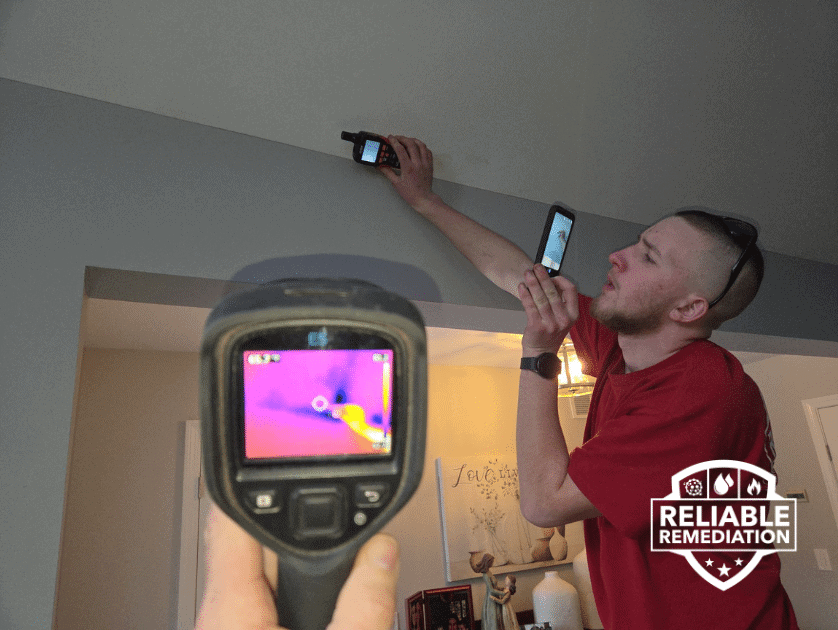
Mold is never the actual problem; it is always the symptom of an underlying moisture issue. During an evaluation, we use specialized tools like thermal imaging cameras (FLIR) to detect temperature differences caused by hidden moisture behind walls and ceilings. We also use pin and pinless moisture meters to measure the exact moisture content (MC) of building materials. If wood framing measures below 16% moisture content, it cannot support active mold growth, regardless of what a visual stain looks like.
2. Identifying the Root Moisture Source
Anyone can spray or wipe visible surface growth, but an expert solves the underlying problem so the mold never returns. We inspect both the interior and exterior of your home, evaluating rooflines, gutter downspouts, ground slope, foundation walls, and indoor relative humidity levels to pinpoint exactly where the water is coming from.
3. Comprehensive Written Photo Report
You do not just get a single dollar figure. You receive a detailed photo report documenting every area inspected, thermal images, moisture readings, and photo notes. This report gives you complete clarity and serves as vital documentation for your records, real estate transactions, or insurance claims.
4. Over 40% of Our Evaluations Require NO Professional Remediation
Because we are paid for our diagnostic expertise rather than a sales pitch, we have zero incentive to exaggerate a problem. In fact, over 40% of the evaluations we perform across Eastern CT end with us telling the homeowner that professional remediation is completely unnecessary. Whether it is historic water staining from a roof leak that was already repaired, or a minor humidity bloom on a hard bathroom surface that you can easily clean yourself with detergent and water, we give you the facts and empower you with simple DIY guidance.
The $250 Evaluation Credit: Integrity Guaranteed
We believe in doing the right thing, even if it means walking away without a sale. Our diagnostic professional mold evaluation is a flat $250 unbiased assessment.
To remove all financial fear for our clients, we offer an Unbiased Evaluation Credit: if our evaluation determines that professional remediation is truly necessary and you choose to move forward with Reliable Remediation for the project, 100% of the $250 fee is credited directly back to your final bill. This makes the diagnostic evaluation functionally free when cleanup is required, while ensuring you pay only for honest, unbiased expertise if no work is needed.
Our Simple Three-Step Plan to Restore Your Home
We make it easy to go from uncertainty to complete peace of mind:
- Get an Evaluation: Call us for an unbiased diagnostic inspection using thermal imaging and moisture meters.
- Receive a Customized Plan: We review our photo findings with you and provide a clear, line-by-line strategy.
- Restore Your Home: Our certified experts execute the plan safely, returning your home to a healthy, clean condition.
Taking action with a trusted local guide eliminates the confusion and protects your home's value. Let us help you get your life back so you can breathe easy knowing your home is safe.